
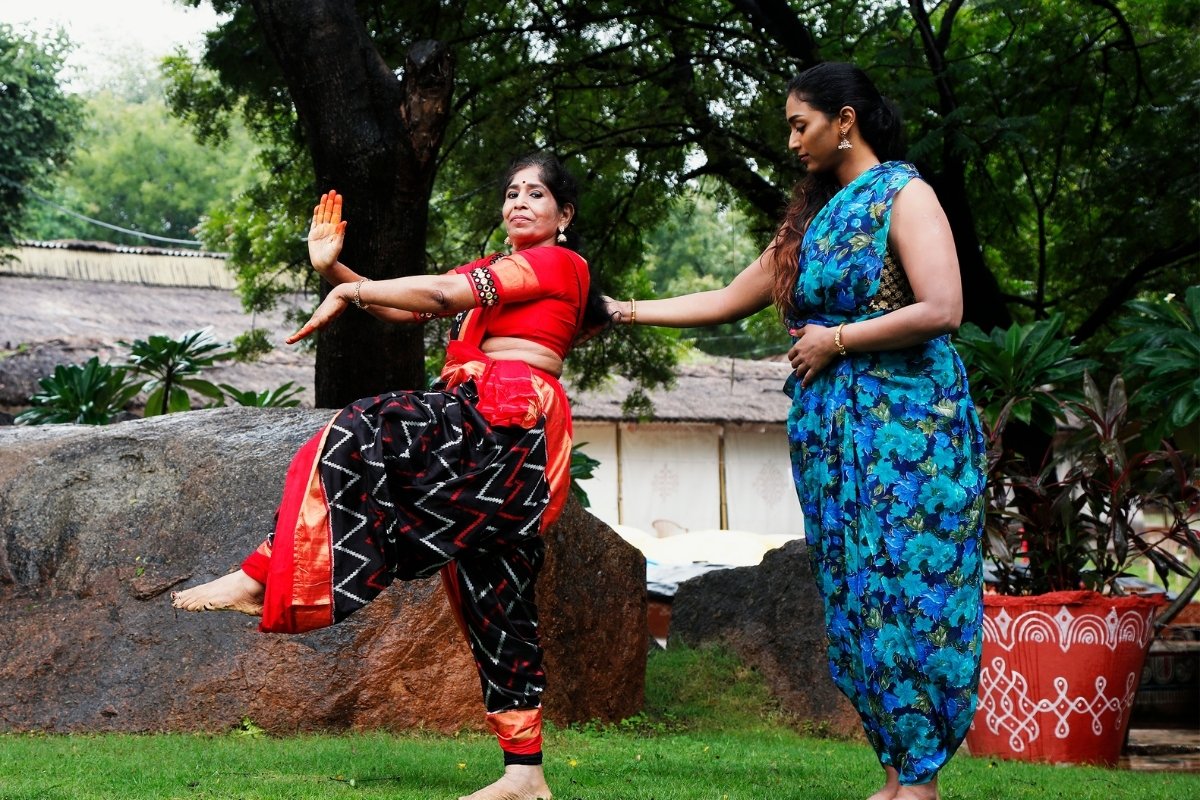
There is a question I get more often than almost any other.
The Assumption That Stops Most Adults Before They Start
Most people picture Bharatanatyam as something that begins at age five. A little girl in a silk pavadai, already folded into Araimandi, already belonging to the art in a way adults feel they no longer can.
That image is real. But the conclusion people draw from it is not.
The body adapts at any age. What changes is the timeline and the path. Neither makes it impossible. They just make it different.
Here is what that difference actually looks like.
The One Thing No One Tells Adult Beginners
Adults do not struggle with discipline. They struggle with permission.
A child never asks whether she deserves to begin. She just begins. Adults have spent years telling themselves they missed the window, that starting now is somehow indulgent or pointless, that they will look wierd next to younger students.
None of that is true. But it is the real barrier. Not the Araimandi. Not the rhythm. The internal negotiation over whether they are allowed to want this.
Once that resolves, adult learners are often more committed than anyone else in the room. They practise consistently. They ask better questions. They understand what they are working toward because they chose it.
And the abhinaya, the expression that trips adults up at first, eventually becomes their strength.
What the Timeline Actually Looks Like
- First few months: Learning foundational adavus: Tattadavu, Nattadavu, Kuttadavu. The rhythm starts to make sense. The body starts to cooperate.
- One to two years: With two classes a week and consistent practice, most adults are ready for group performance. This is a realistic, achievable goal.
- Two to six years: For those working toward an Arangetram, the full solo debut recital requiring mastery of the Margam. A long commitment, and a meaningful one.
Some of the most devoted students I have taught have danced for years with no Arangetram in mind. They came for the practice itself. That is a legitimate path and, for many adults, the right one.
What You Actually Need to Start
- Prior dance experience: None needed.
- Musical background: Not required. Openness to Carnatic music is enough.
- Physical fitness: Helpful, not essential. Students have started with bad knees and stiff backs. We work with what is there.
- Time: Two classes a week minimum.
- Age: We have welcomed students well into their sixties. Some have performed in group events within two years of starting.
The one thing that matters more than any of these: a teacher who knows how to work with adults. Not every approach that works for children translates. The adjustment period, the self-consciousness, the way adults process feedback, all of it requires a different kind of teaching.
On Learning Online as an Adult
Online classes have genuinely improved in quality over the last few years, and for adults with work and family commitments, the flexibility matters. Our online adult batches run in the evenings, with recorded sessions available to review at your own pace.
One practical note: a non-slip floor and a full-length mirror make a bigger difference than most people expect. When your teacher is not in the room, seeing your own form is the next best thing to being corrected.
For students who want closer attention on posture or rhythm, one-to-one sessions are available alongside group classes.
You Do Not Have to Feel Ready
Most adults who finally start Bharatanatyam say the same thing afterward: they wish they had started sooner. Not because it was easy, but because the waiting was based on a feeling, not a fact.
You are not too old. You have not missed anything permanent. The art is still here. So is the practice, the discipline, the strange and quiet transformation that happens when a body learns to move with intention.

Success Stories
Vyshnavie Natya Centre (VNC) is redefining the classical dance landscape by opening its doors to older women who wish to reclaim their passion, proving that the language of dance knows no age bar. By providing a structured, supportive environment that accounts for adult body mechanics and complex schedules, the academy allows women to embrace the rigorous discipline of Bharatanatyam later in life. For these women, step-by-step training at the institute becomes a deeply therapeutic and empowering journey, transforming the dance floor into a space of artistic rejuvenation, personal growth, and profound self-expression.
Trailblazers like Dr. Rajshri Reddy, a practicing gynecologist, and Dr. Lalita Anand, a professor, demonstrate that intellectual brilliance, demanding careers, and classical dance can seamlessly coexist. By performing their grand Arangetrams well past the age of 55, they send a powerful message to society: it is never too late to pursue a lifelong dream or cultivate a new identity. Their dedication serves as a living inspiration for family members, colleagues, and younger students at the academy, illustrating that age is merely a number when fuelled by absolute focus and dedication. Through their milestones, VNC continues to foster a community where women are encouraged to shatter stereotypes and dance with pride at any stage of life.
That is available to you now, at whatever age you are reading this.
If you have been thinking about this for a while, the first class is the only step that matters right now. VNC Artha offers a free trial class for adult beginners, online and in studio, no experience required.
Start with one class → www.vncartha.com/get-in-touch
Frequently Asked Questions
Can I learn Bharatanatyam as an adult with no prior dance experience?
Yes. No prior experience is needed. Adult beginners typically go through an adjustment period, particularly with the Araimandi stance and rhythm, but with consistent practice and the right teaching, progress is very achievable.
Can I learn Bharatanatyam at 30, 40, or even 50?
Yes. There is no upper age limit. Students in their forties and fifties have enrolled at VNC Artha and performed in group events. The pace differs from a child’s, but the art is fully accessible.
How long does it take for an adult to learn Bharatanatyam basics?
Most adult beginners are comfortable with foundational adavus within two to four months of regular practice. Moving confidently in rhythm typically comes within six months. Group performance is realistic within one to two years.
How much time do I need to practise each week?
Two classes a week plus fifteen minutes of daily home practice is the minimum that produces steady progress. More is better, but this is a manageable starting point for people with full-time work and family commitments.
Is Bharatanatyam physically demanding for adults?
It requires building strength in the thighs, hips, and ankles that most adults do not currently have. The first few weeks are physically challenging. With a proper warm-up routine and gradual conditioning, most students find it manageable. Existing knee or back issues can usually be worked around.
Can I do an Arangetram if I start as an adult beginner?
Yes, though it typically takes six to nine years of committed practice from scratch. Many adult students choose a different goal: group performance, personal practice, or cultural reconnection. All of these are equally valid.
Are online Bharatanatyam classes effective for adults?
Yes. Online classes with live instruction, session recordings, and regular feedback work well for adult learners, particularly those balancing work and family. A non-slip floor and a full-length mirror at home make a significant difference to the learning quality.